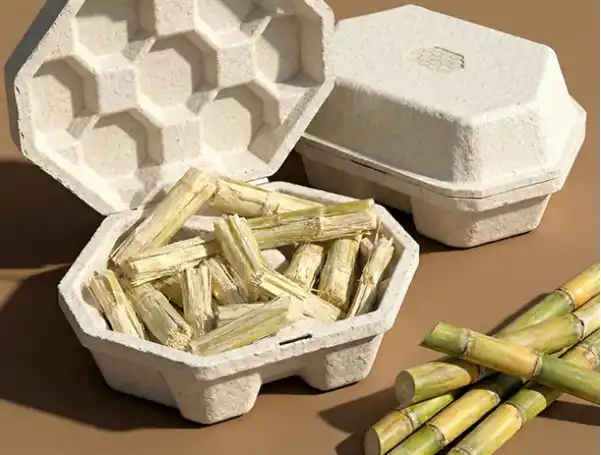
Did you know that sugarcane bagasse, the leftover fiber after sugar extraction, is now a rising star in the world of eco friendly packaging? In the factory, piles of this sugarcane waste are first fed into a shredder to create a fine, thick fiber pulp. This pulp is then placed into a high-heat press, where temperatures exceeding 200 degrees Celsius and high pressure cause the water to evaporate almost instantly, molding it into sturdy yet lightweight eco-friendly panels. This material is not only an excellent alternative to plastic packaging, but the best part is, once discarded, it takes just 90 days to fully biodegrade in nature, transforming into nutrient-rich compost and leaving no burden on the planet.
How is Sugarcane Bagasse Turned into Biodegradable Packaging?
Ⅰ. Collect the Sugarcane Bagasse and Crush It
The production process consists of three main stages: First, Material Transportation, where raw wood chips are uniformly delivered to the processing area via a conveyor belt system. Next is Fine Processing, utilizing mechanical equipment for crushing and grinding. Finally, in the Product Transportation stage, finished products are moved to the storage area by tractor upon completion.


Ⅱ. Pulping
After being centrally collected and sent to a professional factory, the material first enters the core processing stage—initial treatment by a large shredder. This equipment is typically equipped with a high-strength rotor and wear-resistant blades, which quickly crush large chunks of sugarcane bagasse, removing mixed materials such as sugarcane leaves, small branches, and some residual molasses, resulting in more uniform raw material. Next, the processed bagasse is accurately conveyed to the pulping unit, where it is thoroughly mixed with a proportion of water and sent to a specialized high-concentration pulping machine. Under the high-speed shearing, pressing, and rubbing action of the machine, the dry fibers are gradually broken down and refined, ultimately turning into a fine, thick, paste-like fiber slurry. The concentration and flow properties of the slurry can be precisely controlled. The main purpose of this step is to completely break apart the original fiber bundle structure of the sugarcane bagasse, separating the once interwoven plant fibers into individual, dispersed, and uniformly shaped small fibers. Additionally, the moderate friction and shearing action cause slight fibrillation on the fiber surface, growing dense micro-hairs, which significantly enhance the bonding strength between fibers. The resulting slurry not only lays the foundation for subsequent shaping processes such as molding, drying, and curing, but also ensures the strength, uniformity, and stability of the final product. This process enables the high-value utilization of sugarcane bagasse as a biomass resource.


Ⅲ. Shaping
The finely prepared fiber slurry is precisely injected into pre-designed metal molds, with the shape of the mold directly determining the final product's appearance and size. Once the slurry is injected, the mold is smoothly transferred to a hot processing mould machine for the crucial shaping process. Inside the machine, the temperature rapidly rises to over 200°C, while powerful mechanical pressure continuously compresses the mold. Under the dual effects of high temperature and high pressure, the excess moisture in the slurry quickly vaporizes and evaporates, causing the fiber structure to rapidly dehydrate and compact. The natural lignin contained in the sugarcane fibers softens and melts when heated, acting like a natural, eco-friendly adhesive that tightly binds and fuses the previously loose, small fibers together.


How Does Bagasse Packaging Compare to Other Compostable Alternatives?
Are There Companies That Offer Custom Branding On Bagasse Packaging?
OTARAPACK focuses on using sugarcane bagasse renewable fibers as the core material, providing one-stop eco-friendly packaging solutions from product design, R&D, and production to customized delivery. We transform sugarcane bagasse, a byproduct of sugar extraction, into a valuable resource. Through green processes such as pulping, high-temperature molding, and shaping, we produce glue-free, biodegradable, and compostable eco-friendly packaging and food containers. Without consuming wood resources or occupying arable land, we offer brands a truly low-carbon, safe, and cost-effective eco-friendly alternative. From structural design and sample testing to mass production and full delivery, we provide a one-stop service to help businesses easily achieve green packaging upgrades.
Core Advantages of OTARAPACK:
- Focus on Sugarcane Bagasse Eco-Packaging: Using bagasse fibers as raw materials, transforming waste into value, 100% biodegradable and industrial compostable.
- One-stop Full-Chain Service: Covering product design, structural optimization, mold development, production, quality control, and delivery. Eco-friendly and High-Performance: High temperature resistance, water and oil-proof, high strength, no chemical adhesives.
- Customization Development Capability: Supports customization for various scenarios, including cosmetics packaging, food packaging, e-commerce inserts, gift packaging, and more. Stable Production Capacity and Delivery: Mass production with consistent quality, controllable lead times, and suitability for long-term brand partnerships. Low-carbon
- Compliance Advantages: Replacing traditional plastics and paper-plastics, complying with domestic and international environmental policies, and assisting brands with carbon reduction certification.